Operational context
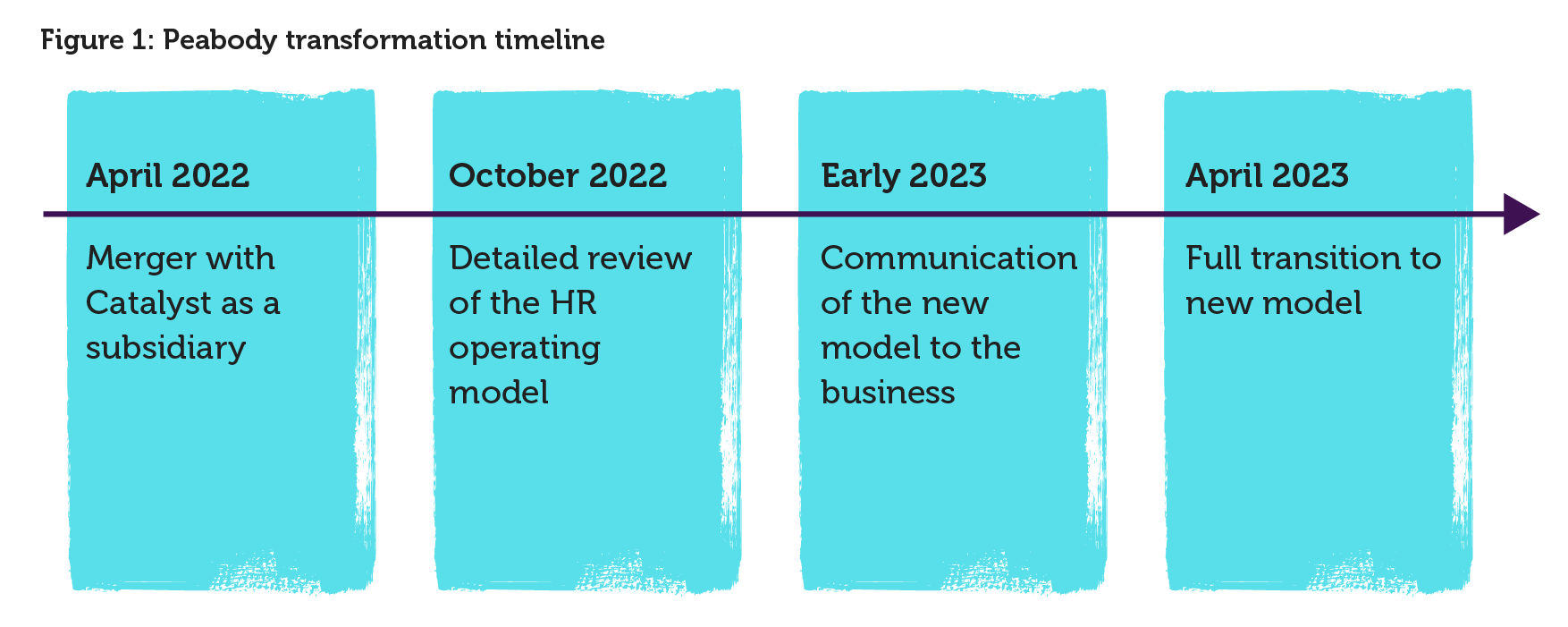
Following a merger with Catalyst in 2022 and the introduction of local plans within each neighbourhood, the business needed to align its people and culture team to deliver local people strategy. This led the team to review how it operated as a function.
Drivers for transforming the HR model
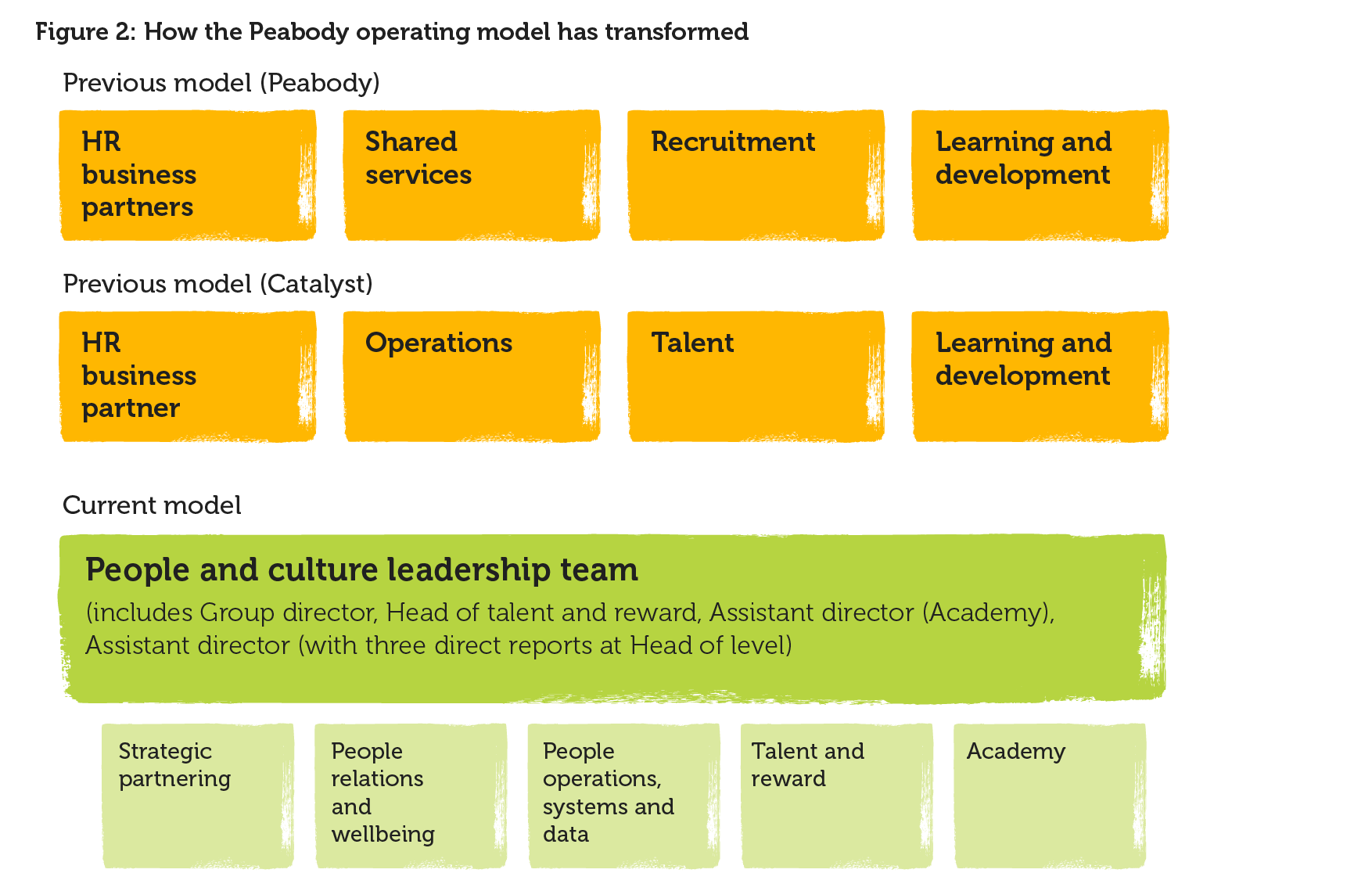
The merger with Catalyst in 2022 meant combining two people teams and prompted the people function to review its operating model. In the previous model, the HR business partner (HRBP) role was operating more transactionally than intended. Andrea Gordon, Group Director of People and Culture at Peabody, explains: “HR business partners, through no fault of their own, weren’t acting as true business partners. The majority of work they did - probably 80% - was spent doing employee relations casework.”
The role has now changed to work more closely with business leaders in a strategic partnering role, completely removing any employee relations work, which is now carried out by a specialist team.
A new approach to learning and development was also needed to offer a more consistent apprenticeship experience to employees, and to make use of the available apprenticeship levy funds.
What they did
Using a simple iterative mapping exercise, Peabody redesigned its operating model in-house by considering what was needed by the business, what was currently being carried out within the people team, and where there were gaps between the two.
The new structure
The transformation began in October 2022 and was fully implemented by April 2023. The following changes were made:
- HR business partners were removed and changed to strategic partners: These roles act as a broker between the people team and the business. Employee relations was removed from the role to enable them to focus on strategic activity. Strategic partners are aligned to one area of the business to create local people plans and implement overall corporate people strategy, workforce planning and business projects, and to take a proactive approach in their area of the business.
- People consultants were introduced: They report to the strategic partners and support with projects, TUPE and delivery of local people plans.
- The more traditional L&D team transitioned into an academy: In addition to providing learning and development, this is a registered apprenticeship provider and provides apprenticeships to employees. The future ambition is to develop this offering further and provide apprenticeships to the residents and community that Peabody serves, as well as other external organisations.
- Reward and talent teams were consolidated to create a joint function: Previously, the business had a recruitment team but no dedicated reward team. Peabody wanted to tie reward and talent together to create a stronger employee value proposition to attract new talent into the organisation.
- The people relations, engagement and wellbeing teams were combined: Insights from people relations issues, sickness absence data and engagement surveys can now be used to inform a more effective and holistic wellbeing strategy.
- A separate data team was created in the people operations team: This was to build capability in data-informed decision-making, but the team also produces monthly people dashboards across directorates to provide insight and inform strategy for future people projects.
Enablers
There were several key enablers to ensure the model was implemented and embedded effectively:
- Building new role profiles: This has helped to communicate the new roles, expectations and key deliverables. Colleagues in these new roles have been supported by ongoing skills development, peer learning and CIPD training, where specific upskilling was needed.
- Drawing on internal data analytics skills to drive decision-making: Using data skills from within the business has enabled the people function to build dashboards and analytics. As Andrea Gordon explains: “Data and narrative are now used to drive solutions, so our people solutions are more proactive and targeted than they have ever been.”
- Having regular touchpoints with key stakeholders: By holding regular meetings with the people and culture leadership team, key stakeholders across the business have been actively involved in the transformation. Becky Russell, Head of Strategic Partnering, says: “Having those stakeholder meetings [gave us] the opportunity to talk, share and understand what's coming through the pipeline, so that the business can effectively prepare. It’s been really useful.”
Challenge areas
A key challenge has been shifting the mindsets and expectations of the people team to align with the new roles and the new people team structure. To help support this, the people team has focused on:
- providing clarity around handoffs between different teams
- embedding local people plans
- separating strategic and operational tasks between strategic partners and other colleagues in the people and culture team
- realigning expectations of the strategic partner role to ensure potential candidates understand the necessary skill requirements. As Andrea Gordon explains: “It’s a very different role - they need to challenge more and understand financial impact and consequences. Strategic partners need to understand their business area in depth, more than they had done in the past. The transformation resulted in a change of mindset for them [to start] acting more as a ‘broker’ for the rest of the people and culture team.”
Additionally, the HR academy has required significant investment and buy-in from the business to get this initiative off the ground. The administration process to achieve employer learning provider status has required substantial effort to build awareness around what the academy can offer.
Outcomes
Successes of the new model include the following:
- Strategic partners work more strategically and directly with managing directors. They link people data to financial impacts and act as a ‘broker’ to other parts of the people function. They are developing localised people plans based on a deeper understanding of the business area and are coaching and developing leaders.
- There is better use of the apprenticeship levy, and existing skills and knowledge from around the business are being drawn on (for example, using existing data analytics and project management skills to offer more targeted and flexible learning options).
- The ‘right people are in the right roles’. There is clearer accountability for different tasks, as well as more structured scoping and management of people projects. This includes holding the business to account and HR acting more as a facilitator on people projects.
- Data informs the decision-making around wellbeing initiatives. By closely aligning the people relations and wellbeing teams, more data is available to inform effective wellbeing initiatives.
Continuous review and improvement
Peabody will continue to review the operating model to ensure it keeps providing the right outcomes for the business. Another improvement area is the expansion of the apprenticeship scheme. Peabody hopes to:
- leverage the scheme with other housing associations as an external provider, thus creating an additional revenue stream
- develop and build on existing skills to create new revenue streams, such as offering retrofitting services to other organisations.
Top tips for a successful transformation
- Be clear about the business needs from the people function and how you’re going to deliver this: Identify the gaps within the current structure and plan how the people function needs to evolve to address these gaps.
- Leverage existing skills within the organisation: It may be possible to draw on data analysis and project management skills in other teams, for example. Where other skills are needed, be realistic about the time it will take to hire suitable candidates.
- Build a sustainable transformation plan, consider succession planning and skills development, and clearly define roles within the function: This will help to retain talent within the people team and reflect career opportunities and growth areas.
- Create new ways of working to avoid bouncing back to old habits: This includes a review of what a ‘day in the life’ looks like for each role, setting clear expectations, deliverables and handoff points.
- Expect some teething problems and review the model: Be creative to meet your longer-term goals and continue to review and evolve your operating model, adapting to organisational changes where necessary.