
Thought leadership
Responsible AI adoption at work: Research findings and guidance from the CIPD supported by UK Government funding
Findings from CIPD’s work as part of the UK Government-funded Innovate UK BridgeAI programme

AI is already reshaping how work is done, and organisations are looking for practical ways to support continual upskilling – not one-off training, but approaches that evolve alongside how AI is used in practice.
However, many organisations are adopting AI without the work design and organisational capability needed to support this effectively. Rather than following a structured approach to understanding how roles, tasks and skills are changing, skills development is often reactive or disconnected from how AI is actually being deployed.
New CIPD research, drawing on action research and a survey over 1,300 senior decision makers and HR professionals, highlights this gap. It shows that organisations need a more staged and practical approach to skills planning – one that aligns reskilling and upskilling with how AI is being used at different points in the adoption journey.
Find out more in the article below, part of CIPD's work with the UK government-funded Innovate UK BridgeAI programme.
The survey highlights a clear pattern, around 45% of organisations report that their use of AI is still ad hoc or experimental, while only a small minority have fully integrated it into core operations.
However, this experimentation is often taking place without the organisational foundations typically associated with effective technology adoption.
Many organisations report weaker capability across:
This is reflected in the survey data: around 42% of organisations experimenting with AI fall into the lowest organisational readiness group, meaning they lack strength across these core capability areas.
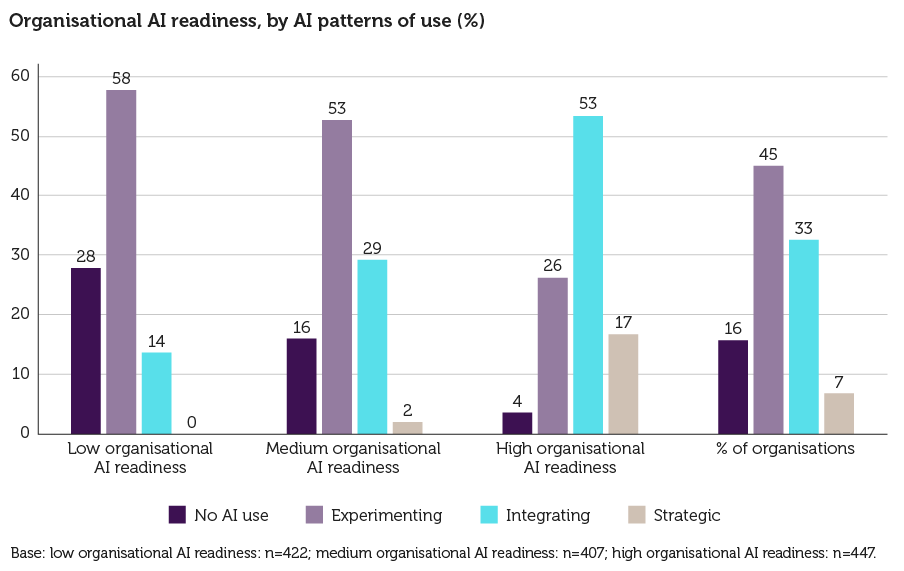
Source: The survey was conducted on behalf of the CIPD by YouGov, between 14 January and 3 February 2026. The total sample size was 1,342 people professionals and business leaders.
Taken together, this suggests that experimentation is frequently happening ahead of the organisational conditions needed to support it. Without these foundations in place, there is a greater risk that AI use remains fragmented, poorly governed or fails to deliver meaningful improvements.
Alongside these broader capability gaps, the research highlights a more specific challenge: how organisations manage the impact of AI on work and skills.
Evidence from the research shows that AI is primarily reshaping work within roles, rather than leading to immediate large-scale job loss. Tasks are changing, skill requirements are evolving and workflows are being reconfigured.
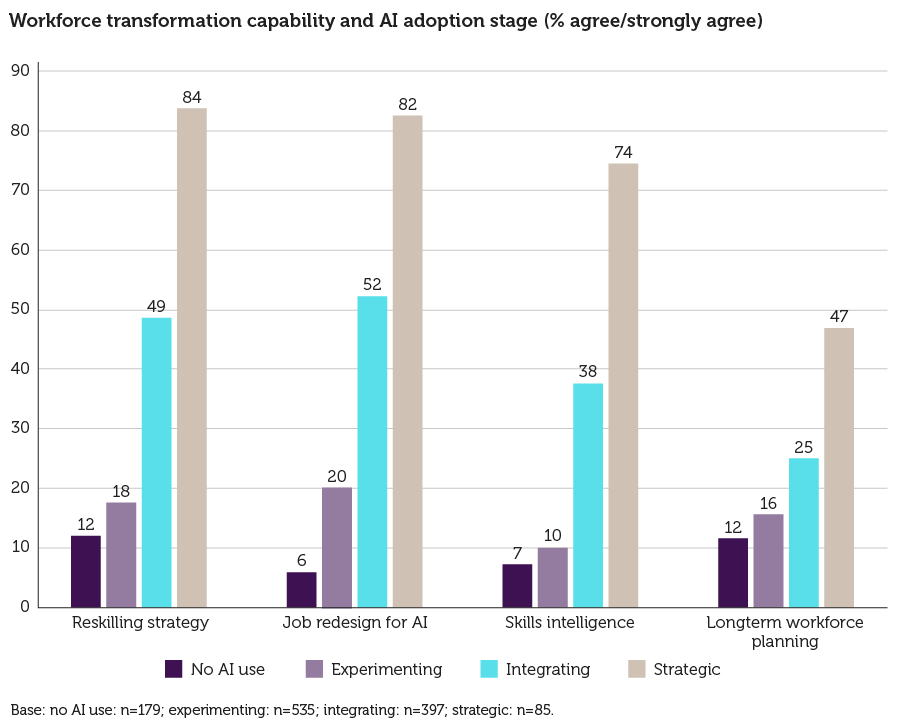
However, organisations vary significantly in how they are responding to these changes. Those further along in their adoption journey are significantly more likely to report activity in key areas of workforce transformation, particularly:
Among organisations where AI is strategically embedded, over 80% report both job redesign and reskilling activity. By contrast, organisations still experimenting with AI are far less likely to have these in place.
This points to a clear divide. Organisations that move beyond experimentation are not just using AI more – they are more likely to be adapting work and skills alongside it.
The challenge is not simply adopting AI but building the capability to manage its impact on work, jobs and skills.
If organisations do not take a more structured approach to AI skills planning, several risks are already emerging.
As AI takes on more routine tasks, there is a risk that employees —particularly those early in their careers — have fewer opportunities to build foundational skills through practice. Over time, this can weaken capability rather than strengthen it.
While AI can reduce time spent on certain tasks, this does not automatically lead to improved job quality. In many cases, expectations around output increase, meaning employees are required to do more rather than differently.
Changes to task composition can make roles, and progression routes, less clear. Without deliberate planning, these risks create gaps in development pathways and limit progression opportunities.
Organisations may focus on short-term time savings rather than longer-term improvements in performance or job quality. This can limit the potential benefits of AI adoption.
Without a clear approach to skills planning, there is a risk that AI is implemented in ways that weaken capability, intensify work and disrupt progression rather than improve performance.
A common mistake is to treat AI skills planning as a one-off exercise, often focused on large-scale training or reskilling programmes. However, effective AI skills planning needs to align with where an organisation is in its adoption journey.
As CIPD’s practical guidance highlights, AI adoption typically follows a staged pattern — from early experimentation, through operational pilots, to more strategic integration.
Each stage brings different workforce challenges and requires a different response.
At the early stage, AI use is typically informal and exploratory. Employees may already be using tools in their day-to-day work, often without clear oversight.
The priority at this stage is to move from uncertainty to informed experimentation. This means focusing on:
This stage is less about advanced capability and more about developing a shared understanding of what AI can and cannot do and establishing the foundations for more structured use.
As organisations move into more structured use, the focus shifts. AI is now being used in pilots or specific functions, and the challenge becomes ensuring it is used effectively and delivers value. This requires developing:
At this stage, skills planning becomes more structured but remains closely tied to real use cases and operational learning.
At more advanced stages, AI is embedded in how work is organised and delivered. The focus shifts from individual use cases to broader organisational change.
This is where skills planning connects directly to:
At this stage, organisations need to take a more strategic and system-level view of how work is evolving. This includes making more fundamental decisions about how roles change, how teams are organised, and how people are supported to transition into new forms of work.
Skills planning becomes an integral part of wider organisational transformation, rather than a standalone activity.
The key message for HR is not to do everything at once.
The evidence suggests that AI adoption is often moving faster than the systems needed to support it. Skills planning needs to catch up, but in a structured and proportionate way. That means:
In other words, the question is not simply:
'What skills do we need for AI?' it is 'What skills do we need next, given how AI is actually being used in our organisation?'
AI is reshaping work in ways that are often gradual but cumulative, changing tasks, roles and skill requirements over time.
Organisations that respond effectively will be those that align their skills planning with how AI is being adopted in practice, rather than relying on one-off or overly broad interventions.
For HR, this means taking a more dynamic and staged approach — one that builds capability progressively and supports organisations to move from experimentation to effective workforce transformation.

Lizzie is a policy and research professional with over 13 years’ experience in the employment and skills arena, having worked with both the public and private sector to develop high-quality research to inform organisational practice, public policy and shape the public debate.
Prior to joining the CIPD Lizzie led The Work Foundation's research and policy development on the youth labour market – and has published a number of influential reports on youth unemployment. She has regularly appeared on national and regional TV and radio, including BBC Breakfast, BBC the One Show, the Today Programme and Channel 4 news. Lizzie graduated in Sociology and has a master's degree in Social Science Research Methods, both from the University of Glasgow.
Findings from CIPD’s work as part of the UK Government-funded Innovate UK BridgeAI programme

An annual benchmark of job quality in the UK, providing data and evidence-based insight on how to improve work and working lives

Listen to episodes from our CIPD Ireland Podcast Series on a range of topical workplace, HR and L&D issues
Listen now
AI is moving from experimentation to everyday infrastructure. For HR teams, that shift brings a practical question: how do we make productivity gains while protecting the conditions for good work — fairness, capability, sustainable performance and employee trust?
Findings from CIPD’s work as part of the UK Government-funded Innovate UK BridgeAI programme
AI is moving from experimentation to everyday infrastructure. For HR teams, that shift brings a practical question: how do we make productivity gains while protecting the conditions for good work — fairness, capability, sustainable performance and employee trust?

AI is exposing gaps in how HR and leadership skills are applied. The challenge is not acquiring new skills but using existing ones to manage workforce change effectively

Discover how the CIPD and the Institute for the Future of Work (IFOW) found insights from eight diverse case studies around the friction between AI and workforce stability. Learn why strategic pauses are necessary and why safeguarding your organisation’s future expertise is essential